Power and low-voltage electrical installation at family-house scale, from one team
From the distribution board to the last socket, from structured cabling to the camera system, from the KNX bus to shading automation: design, installation and documentation of your home’s entire electrical system within one team. In new builds we plan the routes together with the structure. We work in English.
What we offer
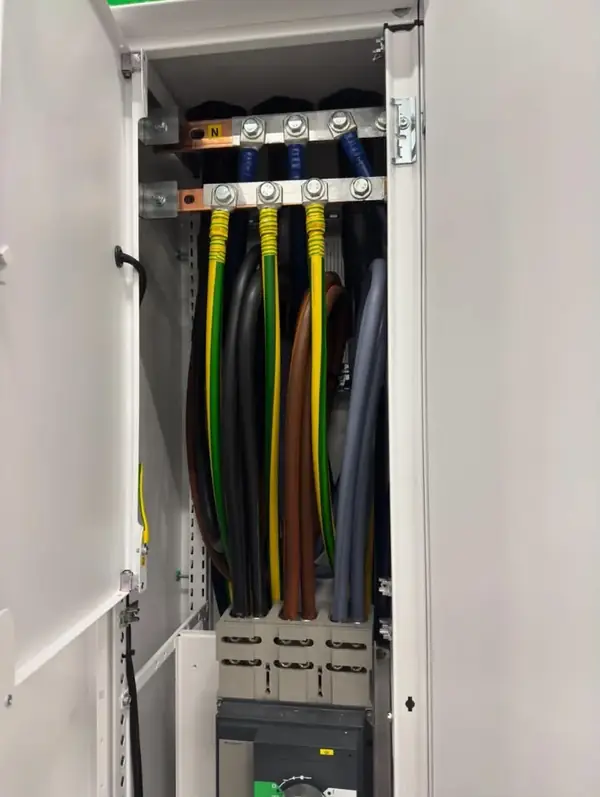
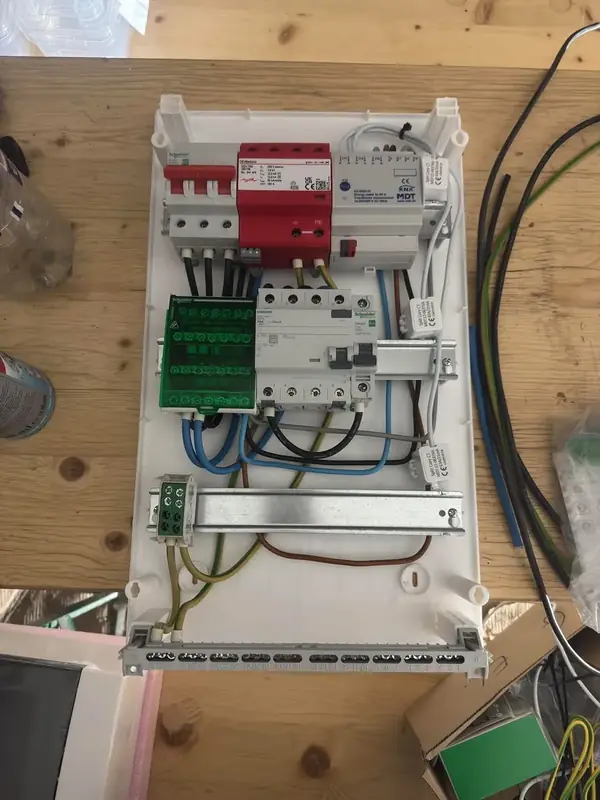
Meter connection, distribution board, circuits, outlets, fittings — the complete wiring of a family house with a budget, to standard.
Read more →Structured cabling and Wi-Fi, CCTV, alarm, access control, video intercom.
Read more →Lighting, shading, heating-cooling, access, energy metering — on an open standard, designed and programmed in-house.
Read more →Wallbox installation and commissioning: dedicated circuit and protection, sized supply, and a capacity upgrade with the utility where needed.
Read more →Power and low-voltage drawings for the simplified permit and for construction, with our design partner Clevertech Engineering Office.
Read more →Retrofitting without chasing walls: we also install Shelly, Sonoff, Aqara and Home Assistant devices as a MarketCom installation partner — smart home installation.
CCTV for family homes – wired or Wi-Fi, with prices: CCTV installation.
What is the difference between power and low-voltage installation?
Power (erősáram) is the 230/400 V network: lighting, sockets, kitchen appliances, heating-cooling, EV charger — everything that comes from the utility and reaches the house through the distribution board.
Low voltage (gyengeáram) is signal and data: systems below 50 V (typically 12–48 V, SELV) such as network cabling, cameras, alarm, access control, intercom and the KNX bus (29 V).
The two worlds need separate cabling, separate routes and separate rules, but they are built in the same house at the same time — which is why it makes sense to keep them with one contractor. For further details, click here: power · low voltage.
How much does electrical installation cost in Hungary in 2026?
There are three common ways to price it, and we use all three depending on what we know about the house or what the client prefers:
| Pricing method | When it fits | Labour | Materials (estimate) |
|---|---|---|---|
| Per outlet (kiállás) | quick, comparable quote when there is no detailed design yet | HUF 10,000–25,000 per outlet | HUF 8,000–20,000 per outlet |
| Per square metre | preliminary estimate from the drawings | HUF 9,000–17,000/m² | HUF 8,000–15,000/m² |
| Itemised budget | the final quotation: materials + labour per item, based on a detailed unpriced bill of quantities, typically for new-build houses | calculated from the design | calculated from the design |
Our company is subject-exempt from VAT (Hungarian small-business exemption), so private clients pay 0% VAT.
Where do we work?
We take on electrical work in all districts of Budapest – mainly in Buda – and in the surrounding towns, including Budaörs, Budakeszi, Törökbálint, Szentendre, Budakalász and Pomáz. Our showroom in the Capital Square office building, at the corner of Váci út and Dózsa György út, welcomes visitors, and from our warehouse in Törökbálint we reach our clients quickly.
Why one contractor for power and low voltage?
Which standards do we work to, and what do you receive?
Power installation follows the MSZ HD 60364 series (the Hungarian implementation of IEC 60364) and the national fire safety code; at handover you receive the electrical safety and insulation resistance test report, a circuit schedule, as-built drawings and, if required, a lightning protection inspection report. Low-voltage networks are tested and labelled endpoint by endpoint. Meter connections and utility paperwork are handled by a utility-registered electrician, a subcontracted partner of ours.
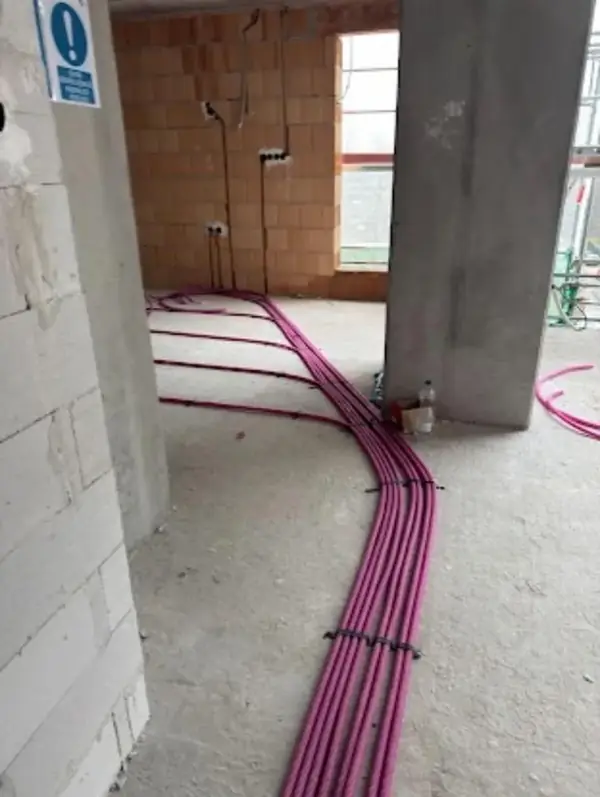
Factory-prepared routes in a precast house
MDRSZ Bau family homes are built from Leier precast double walls in which conduits, boxes and openings are already in place according to the production drawings. This means that once the elements are craned in, only the cables remain to be pulled, so the cost of chasing is saved. For more information, follow these links: general contracting · precast concrete house.
Brands we install





































Frequently asked questions
Do you take on electrical work in Budaörs and the towns around Buda?
Yes. We work in all districts of Budapest – mainly in Buda – and in the surrounding towns, including Budaörs, Törökbálint, Budakeszi, Telki, Páty, Nagykovácsi and Solymár: electrical installation for family homes, KNX smart homes and EV charger installation. From our warehouse in Törökbálint we reach Budaörs and the neighbouring towns quickly.
Do you only do electrical work on your own building projects?
No: we also take on electrical work in houses built by other contractors and in renovations, regardless of project size.
Are you registered with the utility for meter connections?
Yes: meter connections and utility (E.ON / MVM) paperwork are done by our subcontractor, a utility-registered electrician.
Do you also install and connect luminaires?
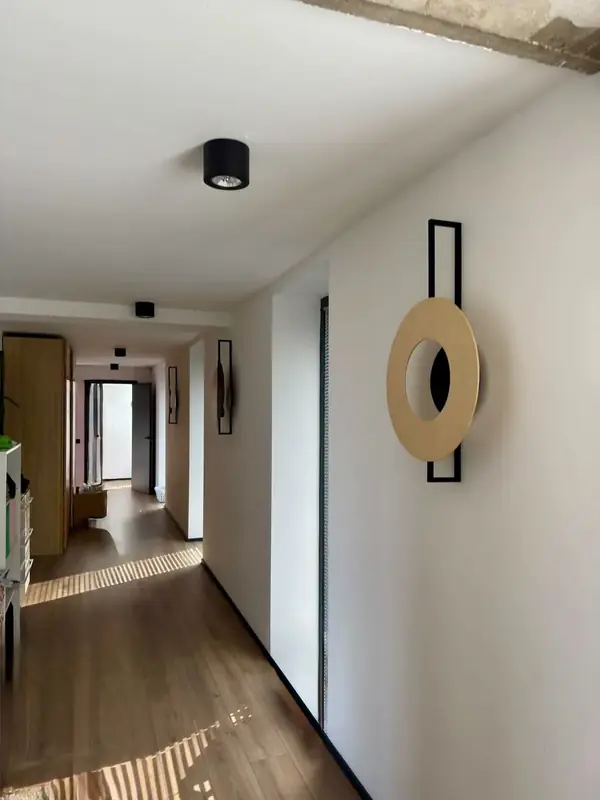
Yes: we install and connect luminaires as well, from conventional ceiling and wall lights to professional track and magnetic systems (for example Prolicht, ACB, Zava or Karizma Luce). We wire them properly and integrate them into the control system, whether KNX, Loxone, DALI or Casambi, so dimming, scenes and automations work together with the rest of the house.
Do you work on renovations?
Yes: we also take on renovations, rewiring and distribution board replacement.
How long does wiring a family house take?
Conduits and boxes go in parallel with the structure (in a precast double wall they are ready from the factory); pulling cables, the board and the fittings typically take 2–4 weeks on a 150 m² house, in stages coordinated with the other trades. In a conventional masonry house it takes considerably longer, typically 5–8 weeks: after the walls are built every route and box position has to be marked out, the channels chased, the box holes drilled, the conduits and boxes fixed and the channels plastered over before any cable can be pulled. With precast double walls this whole chasing-and-conduit phase is skipped, because the conduits and boxes are cast into the wall at the factory.
Do you provide documentation and test reports?
Yes: electrical safety and insulation test report, circuit schedule in the board, as-built drawings, test sheet for the low-voltage endpoints, KNX project file and documentation — in English on request.
Let’s talk about your project.
Tell us what you are planning and we will get back to you within a few days.
Get in touch