Electrical installation from the distribution board to the last socket
We take on the complete electrical installation of family homes in Budapest – mainly in Buda – and the surrounding towns, from the design to the test report, from one team. Wiring a family house is not “pulling cables” but a designed system: meter connection, main feed, distribution board, circuits, outlets, fittings — to standard, tested, documented. Here we explain what it includes, how the budget is built and what to expect in price in 2026.
What does wiring a family house include?
| Part | What it means | Why it matters |
|---|---|---|
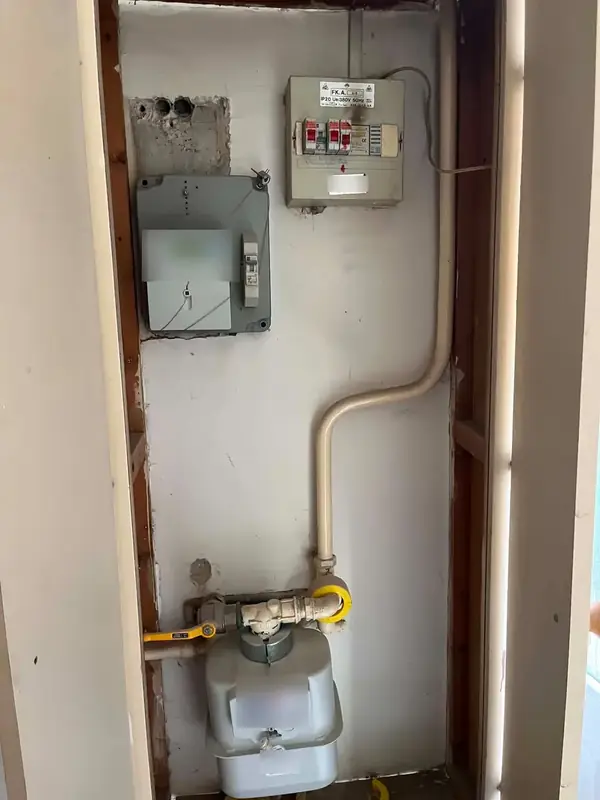
| Meter connection | the utility meter cabinet at the plot boundary, meter, main fuse | to utility rules, by a registered electrician; defines the available capacity (e.g. 3×32 A) |
| Main feed | from the meter to the house distribution board | sized for the capacity and a future EV charger |
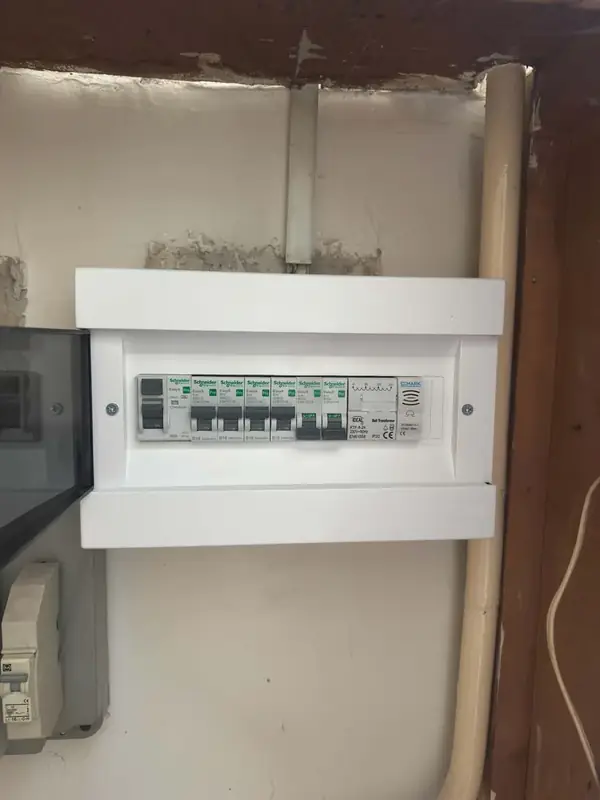
| Distribution board | MCBs, RCDs, surge protection, space for KNX actuators | the “heart” of the house; flush or surface mounted, with spare capacity |
| Circuits | lighting, sockets, kitchen, bathroom, air conditioning, heating, outdoor — each protected separately | more independent circuits mean more safety and flexibility, and consumption can be metered more precisely |
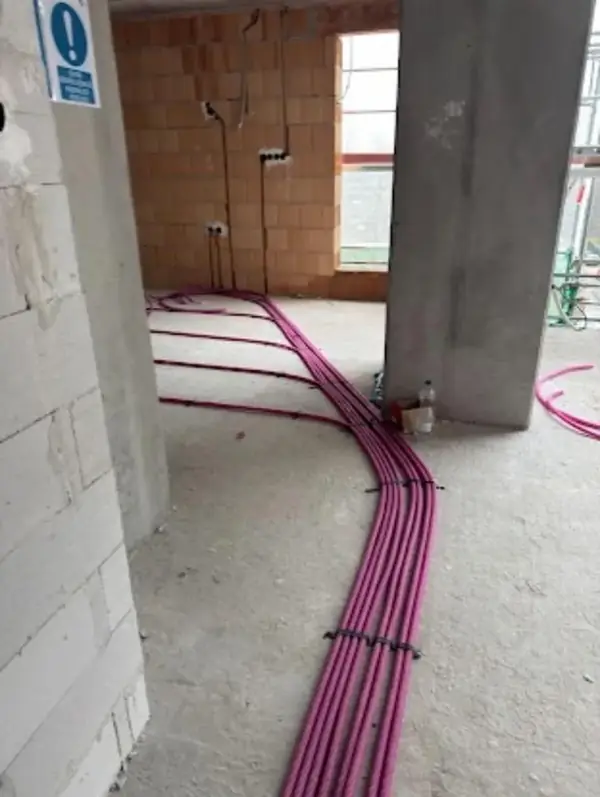
| Outlets (kiállás) | every switch, socket, luminaire and appliance connection point | the basic unit of the budget, and it largely determines the final total, since fittings come in a huge range of products at very different prices |
| Fittings | switches, sockets, cover plates — Gira, Schneider, Legrand | the visible quality; there is a huge choice of colours and materials, it is very much a matter of taste and has a big impact on the price |
| Bonding and lightning protection | equipotential bonding, earthing, lightning protection system where required | life safety; we also design and install lightning protection |
| Outdoor and garden | gate, garden lighting, irrigation, pool, EV charger | separate circuits, IP ratings, buried cable, cable pits, waterproof joints with WAGO and similar gel-box solutions |
How is the electrical budget built?
- 1Wall elevations and ceiling plans
Ideally an interior designer or interior architect draws the wall elevations and ceiling plans showing every switch, socket, light point and appliance connection. If there are no such drawings, wall elevations are still needed: our team helps draw them in AutoCAD, as DWG files. We go through these drawings with the client over several rounds.
- 2Outlet schedule
From the final wall elevations we compile the room-by-room outlet schedule: every switch, socket, light point and appliance connection. This is what allows the installation to be priced precisely.
- 3Design, sizing, circuit plan
Based on the final wall elevations, our partner electrical engineer prepares the electrical design: grouping the outlets into circuits and sizing the cables and protective devices. This determines the size of the board and the cable quantities.
- 4Itemised quotation
An unpriced bill of quantities is prepared from the electrical design, and we price it item by item: materials and labour on separate lines, from cable, conduit and boxes through the distribution board and fittings to testing and documentation. Fittings are priced in the chosen range and colour, so the quotation is precise and comparable, and as an annex to the contract it is the basis for the final invoice.
- 5Options separately
KNX preparation, flush board, designer fittings, EV charger, solar connection — each on its own line so you can decide.
No surprises: the itemised list is an annex to the contract, and if the number of outlets grows during the build, the unit price shows exactly by how much.
How much does electrical installation cost in Hungary in 2026?
In Hungary electrical work is priced per outlet, per square metre or itemised. Indicative figures:
| Item | Price | Note |
|---|---|---|
| Labour per outlet | HUF 10,000–25,000 | excluding materials; with chasing in masonry, without chasing in a precast double wall |
| Complete installation per m² | HUF 12,000–25,000/m² | new family house, average specification |
| A 120–150 m² house in total | HUF 1.5–3.8 million | without KNX; with KNX preparation +10–30 % |
Our company is subject-exempt from VAT (Hungarian small-business exemption), so private clients pay 0% VAT.
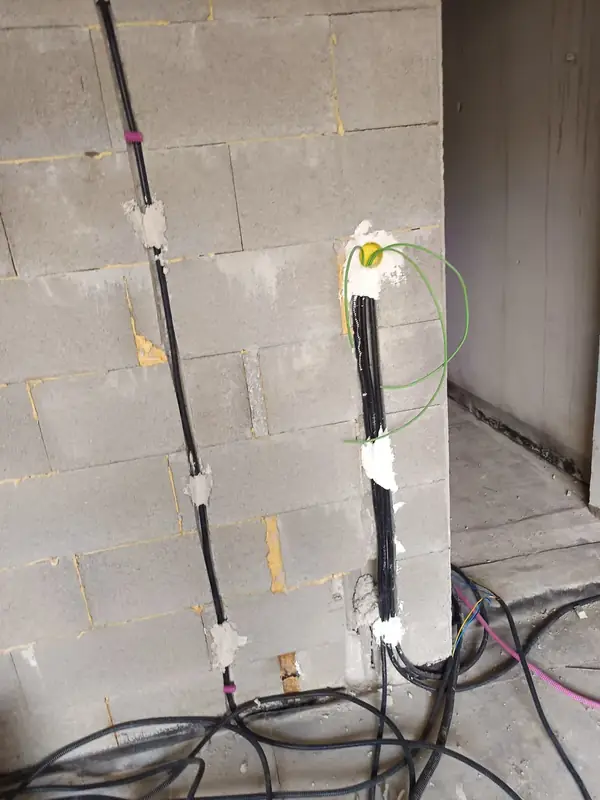
What makes it more expensive: many separate circuits, a flush board, a designer fitting range, outdoor networks, an EV charger, KNX preparation (more conduits and boxes). What makes it cheaper: the precast Leier double wall with conduits and boxes cast in at the factory — chasing and box setting disappear.
How many outlets does a family house need?
Indicative figures: a 120–150 m² family house of average specification usually has 120–180 outlets; a living-kitchen 25–35, a bedroom 8–12, a bathroom 6–10. In a KNX smart home the number of switches drops (one push-button carries several functions) but the number of boxes rises because of sensors, actuators and bus connections. The exact figure comes from the outlet schedule.
EV charger installation and commissioning, solar connection
We install and commission EV chargers (wallboxes). A wallbox (7–22 kW) needs its own circuit, a type A-EV (with 6 mA DC fault detection) or type B RCD and an adequately sized main feed — details: EV charger installation; if the connection capacity is not enough, we request the capacity increase at the meter from the utility. At commissioning we set up the charger, our qualified inspector partner carries out the protection tests, and we hand over a test report. We also connect the AC side of PV systems. For solar, the inverter’s AC connection, surge protection and the meter change are the electrician’s job. In a new house we prepare both in the design — cable and space in the board — even if you only need them later. More: power capacity upgrade · heat pump and solar connection · RCD types.
Which standards do we work to?
- MSZ HD 60364 series (low-voltage electrical installations, the Hungarian implementation of IEC/HD 60364): circuits, protection, cable sizing, bathroom zones.
- National fire safety code (OTSZ): fire switch, cable routes, lightning protection.
- Utility rules (E.ON / MVM): meter connection, registered electrician.
- Handover: electrical safety (protective measures) and insulation resistance test report to MSZ HD 60364-6 and Hungarian Decree 40/2017 (XII. 4.) NGM (Electrical Technical Safety Regulations), tests carried out by our partner, a qualified electrical safety inspector, circuit schedule in the board, as-built drawings; if required, a lightning protection inspection report. For a full check of an existing house: electrical safety inspection.
How does it fit a passive house and a precast double wall?
In a passive house every penetration of the airtight layer and the thermal envelope is a potential defect: boxes in external walls, cables for outdoor lights and sockets use airtight boxes or sealing grommets, and cables through the façade insulation use thermal-bridge-free sleeves. In a Leier double wall the boxes and conduits are cast into the shell at the factory, so the wall’s airtightness is never breached afterwards. The passive house page explains this in detail.
Related articles from our knowledge base
The deciding factor is whether the walls are already plastered. Comparison, package prices, pitfalls.
Read →What an RCD protects, which type an EV charger or heat pump needs, and why an electrician should install it.
Read →LED profile, driver location, voltage drop, dimming – what to settle before the plasterboard goes up.
Read →Leading or trailing edge, minimum load, dimmable bulbs and drivers – how to stop LED flicker.
Read →Light and heavy-duty corrugated, rigid Mü-II and Mü-III conduit: location, 320 or 750 N, and what size the cable needs.
Read →Which wire goes where, changing a light safely, motion sensor lights and chandeliers – and when to call an electrician.
Read →Buried cable and conduit, IP ratings, RCDs, dusk sensors, motion sensors, extra-low voltage – and facade lighting.
Read →What the standard allows in zones 0, 1 and 2, which IP rating you need, where switches go, and good light at the mirror.
Read →Escape and exit-sign lighting, the Hungarian fire code and standards, duration, periodic testing and the log.
Read →What C16 and 6000 mean, how MCBs are sized, when a T1+T2 arrester is needed, and what to check between brands.
Read →Colours, frames, IP44, USB chargers, push-in terminals and smart versions from manufacturer catalogues.
Read →WAGO 221 and 2273, screw and spring terminal blocks: which wire, what current, and where joints are allowed.
Read →Initial verification, declaration of conformity, test reports, lightning protection and the as-built drawing under the Hungarian VMBSZ.
Read →Frequently asked questions
Who deals with the utility and the meter connection?
We do: the meter connection is made by our subcontractor, a registered electrician; we submit the connection and capacity applications and attend the utility acceptance.
When should the electrician be involved?
At design stage — in a precast house necessarily before the production drawings, because boxes and conduits go into the wall at the factory. In a masonry house before bricklaying at the latest, so routes and chases are planned.
Do we need a separate electrical designer?
Not mandatory for a family house under the simplified notification, but recommended for higher capacity, KNX, solar and an EV charger — and we work from drawings. The design is prepared by our partner, Clevertech Engineering Office, for the simplified permit and at construction level — see electrical design.
Do you only do the wiring, or the fittings as well?
The whole system: conduits, boxes, cable pulling, board, fittings, testing, documentation. We supply the fittings (Gira, Schneider, Legrand) or install the range you choose.
What warranty do you give?
As required by law. For new residential buildings, Hungarian Government Decree 181/2003 (XI. 5.) prescribes a mandatory 5-year warranty on the electrical network (cables, conduits and boxes, distribution boards, switches and sockets, luminaires) and on lightning protection, counted from the handover. For renovations and other installation work the statutory liability for defects under the Hungarian Civil Code applies, and installed devices carry the manufacturer’s or statutory warranty.
Let’s talk about your project.
Tell us what you are planning and we will get back to you within a few days.
Get in touch