Electrical conduit: corrugated, “Symalen” or rigid – which goes where, and what size?
Electrical conduit differs in three ways: pliable or rigid, how much compression it withstands (320 N or 750 N), and where it may be installed. Heavy-duty 750 N pliable conduit (corrugated, or the smooth orange Symalen) belongs in the floor and in concrete, light corrugated conduit under plaster and inside drywall, rigid conduit on the wall surface, and the thin-walled Mü-III only in a wall chase. The diameter (16, 20, 25 mm) decides what fits inside.
In short
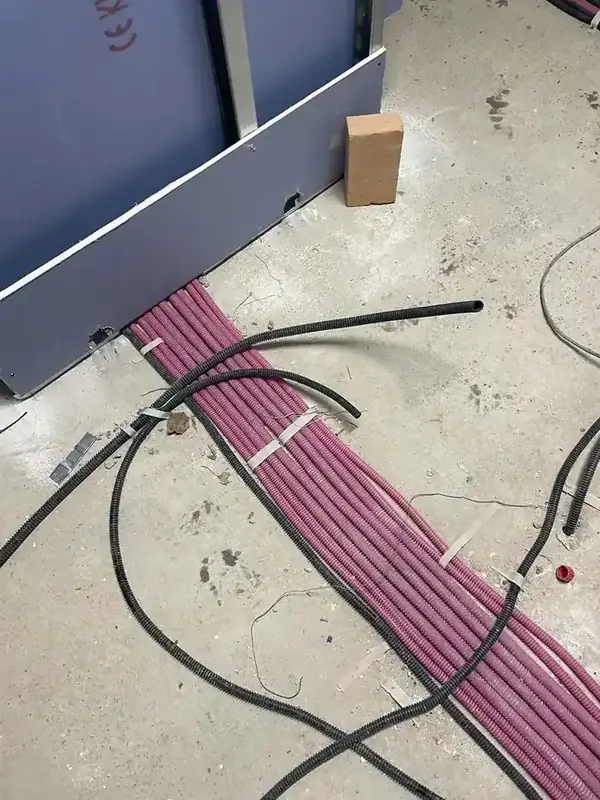
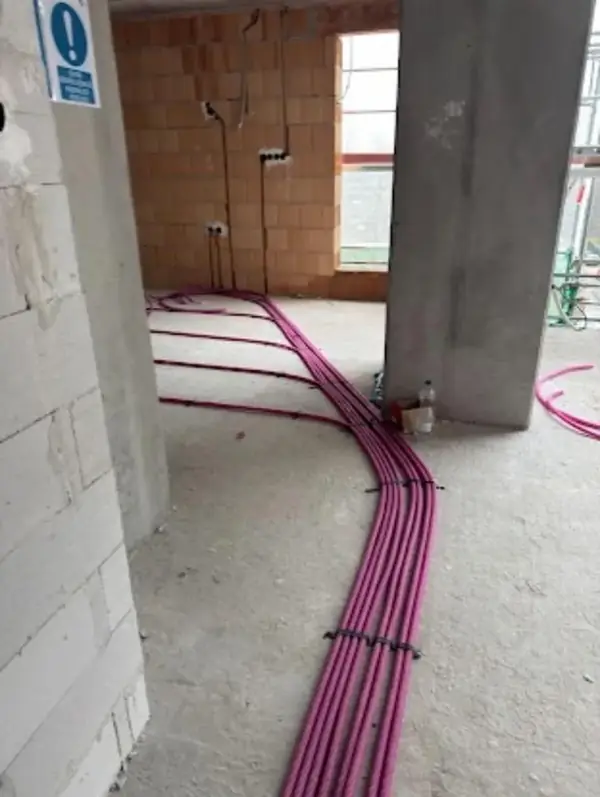
- Under screed, in the subfloor, in concrete: heavy-duty 750 N pliable conduit. People walk on it, wheelbarrows run over it, then the screed is poured.
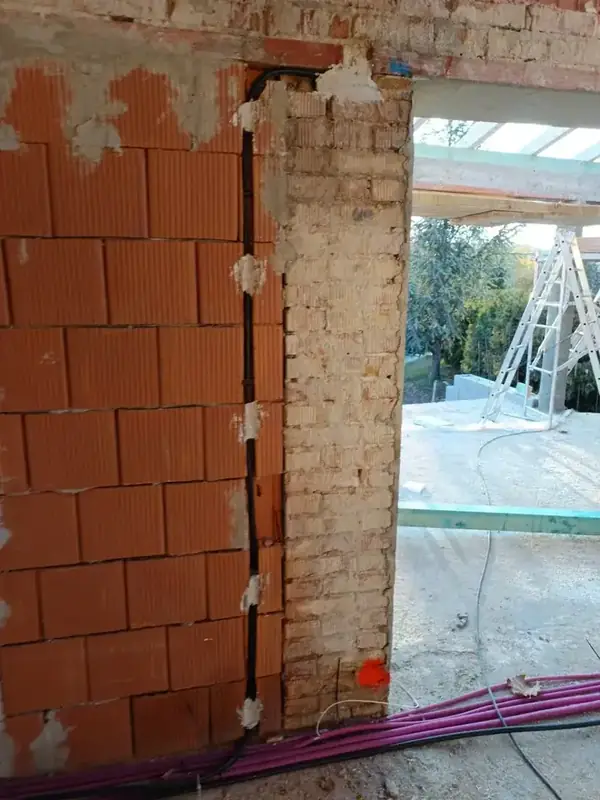
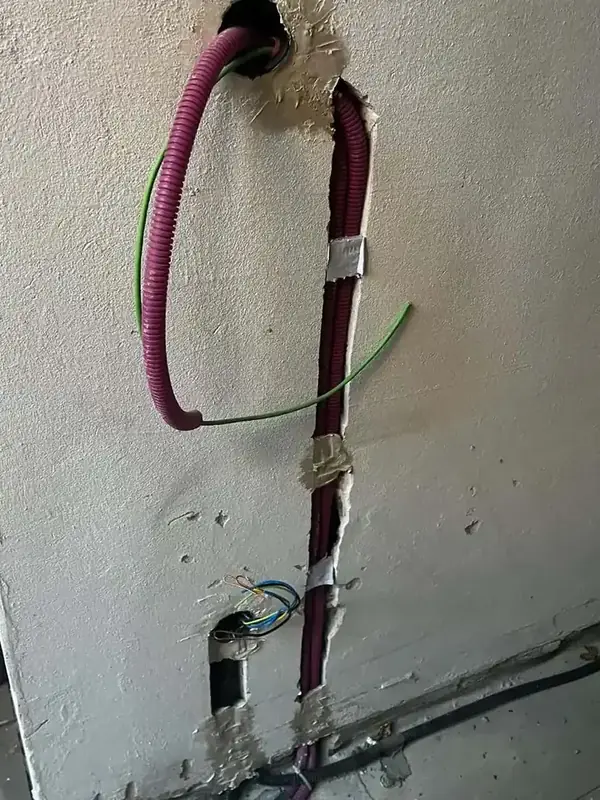
- In a brick wall chase, under plaster: light (320 N) corrugated conduit or thin-walled rigid conduit (Mü-III). Here the wall and the plaster protect the conduit.
- Drywall and suspended ceilings: light corrugated conduit. Nothing presses on it, and it bends by hand between the studs.
- Surface-mounted (basement, garage, plant room): rigid conduit with clips and fittings; where it can be hit, the 750 N version.
- Size: 16, 20, 25 is the outside diameter. As a rule of thumb, the inside diameter should be at least one and a half times the cable diameter.
Author: Norbert Madarász , Managing Director and Partner · Updated: 13 March 2027
Which conduit goes where? The four families
Shops use many names (corrugated conduit, Symalen, Mü-II, Mü-III, Monoflex, heavy-duty), but the plastic conduits used in electrical installation fall into four families. The difference is not the colour but the wall thickness, the flexibility and the standard compression strength.
| Family | Design | Compression | Where it belongs | Where not |
|---|---|---|---|---|
| Light corrugated conduit | pliable, corrugated, thin wall, on a coil | 320 N | wall chase under plaster, drywall, suspended ceiling | in concrete (the manufacturer forbids it), under screed |
| Heavy-duty pliable conduit (corrugated, Symalen) | pliable; corrugated, or smooth-walled PE (Symalen), often halogen-free | 750 N | subfloor, under screed, concrete slab, also wall chases | – |
| Rigid conduit (Mü-II, Mü-I) | smooth, straight lengths, couplers and bends | 320 N or 750 N (marked on the conduit) | surface-mounted with clips, plant rooms, basement, garage | routes with many bends |
| Thin-walled rigid conduit (Mü-III) | smooth, very thin wall | 320 N | wall chase under plaster, above a suspended ceiling | surface-mounted, in the floor |
Manufacturers: electrical conduit is made by Kopos, Fränkische, Dietzel, OBO Bettermann, Pipelife and Tracon among others; flush and junction boxes by Kaiser, Kopos and OBO, for example. The marking on the conduit matters more than the brand: compression strength (320 N, 750 N), flexibility and halogen-free material – under EN 61386 these mean the same for every manufacturer. On joints in boxes: WAGO connector or terminal block?
Heavy-duty corrugated conduit and Symalen: what does 750 N mean?
The mechanical properties of conduits are classified by the EN 61386 series: part 1 covers general requirements, part 21 rigid, part 22 pliable and part 24 buried conduit systems. The five compression classes are 125 N (very light), 320 N (light), 750 N (medium), 1250 N (heavy) and 4000 N (very heavy).
In practice, heavy-duty or “walk-on” conduit means 750 N: under that load it does not flatten so far that the cable can no longer be pulled in. This is a requirement of the location, not a luxury: on the raw floor people walk on it, wheelbarrows run over it and the screed is poured on top. Light 320 N conduit can be crushed in the same place.
How to read it from the conduit
Manufacturers mark the compression strength in newtons and with a numeric code. The first digit of the code is the compression class: 2 = 320 N, 3 = 750 N, 4 = 1250 N. In the Kopos catalogue, for example, the light Monoflex conduit is coded 22212 (320 N) and Super Monoflex 33212 (750 N); Dietzel Univolt’s halogen-free HFXP X is 33433 (750 N).
What is Symalen?
Symalen is the brand name of a polyethylene (PE) conduit by the Swiss company Symalit AG. According to the Hungarian distributor’s datasheet it is orange, smooth-walled, bendable and halogen-free, rated 750 N, installable from -15 to +60 °C and suitable for concrete; the 25 size is about 19 mm inside. So it is not a corrugated conduit, but it belongs to the same heavy-duty 750 N group. Many Hungarian electricians also use the name generically for heavy-duty pliable conduit; unless the specification asks for this exact product, state the properties instead: pliable, 750 N, halogen-free, EN 61386-22. Several manufacturers’ products meet this, for example Dietzel Univolt HFXP or Kopos Super Monoflex HFPP.
Halogen-free: is it needed?
Halogen-free conduit does not release halogen (acidic, corrosive) gases when it burns; Dietzel’s datasheet confirms this by testing to EN 60754 and to EN 61034 for smoke density. Manufacturers mainly recommend it for buildings where many people gather (schools, hospitals, public buildings). In a family house it is a matter of choice; some heavy-duty conduits are halogen-free anyway, PVC conduits are not.
Rigid conduit: Mü-I, Mü-II and Mü-III – what is the difference?
Mü is the old Hungarian designation for plastic conduit (MSZ 9850, now replaced by EN 61386); the Roman numeral indicates the wall thickness. Hungarian shops still sell them under these names:
- Mü-I – thick-walled rigid conduit: according to the manufacturer, for walls, concrete and surface mounting, for medium mechanical stress; typically seen at meter points and outdoors.
- Mü-II – medium-wall rigid conduit: for surface mounting with clips, couplers and bends. On the Hungarian market typically 320 N, but 750 N versions exist.
- Mü-III – thin-walled rigid conduit: according to the datasheet for wall chases or above suspended ceilings; wall thickness about 0.4–0.5 mm (Budvill), compression 320 N. It offers no protection on its own: the plaster and the wall protect it.
So the Mü designation is not a compression class: two “Mü-II” conduits may be rated 320 N and 750 N. Where strength matters (surface-mounted where it can be hit, or in concrete), look at the newton value printed on the conduit, not the Mü number.
Conduit sizes: 16, 20 or 25 – what size does the cable need?
16, 20, 25, 32 is the conduit’s outside diameter in millimetres. The cable has to fit the inside diameter, which differs between types because of the wall thickness and corrugation. Some manufacturer examples:
| Conduit (example) | 16 | 20 | 25 |
|---|---|---|---|
| Light corrugated, 320 N (Kopos Monoflex) | approx. 10.7 mm | approx. 14.1 mm | approx. 18.3 mm |
| Heavy-duty corrugated, 750 N (Kopos Super Monoflex) | approx. 10.7 mm | approx. 14.1 mm | approx. 18.3 mm |
| Heavy-duty, halogen-free, 750 N (Dietzel Univolt HFXP X) | – | approx. 13.3 mm | approx. 17.5 mm |
| Heavy-duty, smooth PE, 750 N (Symalit Symalen M25/19) | – | – | approx. 19 mm |
| Rigid, 320 N (Kopos 15xx) | approx. 13.7 mm | approx. 17.4 mm | approx. 22.1 mm |
| Rigid, 750 N (Kopos 40xx) | approx. 13.0 mm | approx. 16.9 mm | approx. 21.4 mm |
The inside diameter is compared with the cable’s outside diameter. A sheathed installation cable (NYM-J, Faber datasheet) measures about 8.2 mm (3×1.5), 9.4 mm (3×2.5), 9.5 mm (5×1.5) and 11 mm (5×2.5). Our practical rule of thumb (not a value from a standard): the conduit’s inside diameter should be at least one and a half times the diameter of the cable (or cable bundle), because the cable binds in bends and at boxes.
- 3×1.5 (lighting): fits a 16 on short runs with few bends; on longer, curved routes use 20.
- 3×2.5 (socket circuit): 20 pliable conduit.
- 5×1.5 (blinds, small three-phase load): 20.
- 5×2.5 (hob, three-phase circuit): 25 pliable or 20 rigid conduit.
- Several cables in one conduit, trunk between two boxes: size by the bundle diameter, often 25 or 32. The derating of circuits sharing a conduit is taken into account by the designer.
Where does the conduit go in the house? Screed, slab, wall chase, drywall
In a new or fully renovated house the four families go to four places, and the sequence follows from that:
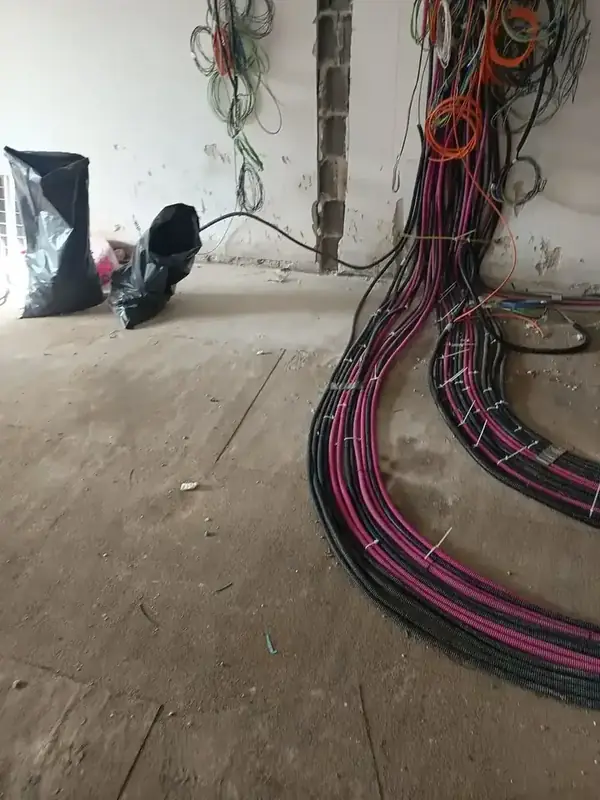
- Subfloor and screed: heavy-duty conduit runs on the raw subfloor, bundled and fixed so it does not float up when the screed is poured. This is where most outlets and crossings are, so it is worth photographing the routes before they disappear.
- Concrete slab: conduit cast into the slab needs 750 N; it goes in after the reinforcement and before pouring, together with the ceiling boxes.
- Brick wall chase: light corrugated conduit or Mü-III, before plastering. The chase depth matches the conduit diameter, and the conduit is fixed in the chase.
- Drywall and suspended ceiling: light corrugated conduit after the frame is up, before boarding.
- Surface-mounted: rigid conduit with clips, where the wall cannot be chased or the wiring must stay accessible.
Installation sequence: what to decide before the conduit goes in?
- Outlets and routes: positions of sockets, switches, lights and smart home devices, planned with the furniture. After the conduit is in, every change means chasing walls.
- Conduit type by location: floor and slab 750 N, chases and drywall can be 320 N, surface-mounted rigid conduit.
- Diameter by cable, with reserve: where a cable may come later (KNX, network, blinds), an empty conduit with a draw wire.
- Installation and check: every conduit passable, ends sealed so no concrete or plaster gets in.
- Pulling in: pull the cables in before the screed and the plaster, or at least test that they can be pulled; a crushed or blocked conduit can only be repaired by breaking it open.
More: Electrical installation · Electrical design · KNX smart home · KNX or wireless smart home?
Related articles from our knowledge base
Which cable category, how many points, what a patch panel does, T568A or T568B, and what to test before handover.
Read →Buried cable and conduit, IP ratings, RCDs, dusk sensors, motion sensors, extra-low voltage – and facade lighting.
Read →WAGO 221 and 2273, screw and spring terminal blocks: which wire, what current, and where joints are allowed.
Read →Frequently asked questions
What is the difference between corrugated conduit and conduit in general?
Conduit is the generic term for any tube that protects wiring mechanically. Corrugated conduit is the pliable, ribbed kind; it can be light (320 N) or heavy-duty (750 N).
What does heavy-duty (walk-on) corrugated conduit mean?
Pliable conduit with a compression strength of at least 750 N (the medium class of EN 61386). It is required under screed, in the subfloor and in concrete, where people walk on it and concrete is poured on top.
What is Symalen?
The brand name of a polyethylene conduit by the Swiss company Symalit AG. According to the distributor’s datasheet it is orange, smooth-walled, bendable, halogen-free and rated 750 N, also for concrete. Hungarian electricians also use the name generically for heavy-duty pliable conduit; a specification should state the properties (pliable, 750 N, halogen-free).
What is the difference between Mü-II and Mü-III conduit?
Both are rigid, smooth plastic conduits. Mü-II has a medium wall for surface mounting with fittings; Mü-III is thin-walled, only for wall chases under plaster or above suspended ceilings. The compression strength is the newton value on the conduit, not the Mü number.
What size conduit does a 3×2.5 cable need?
Typically 20. A 3×2.5 sheathed cable is about 9.4 mm, a 20 corrugated conduit about 13–14 mm inside, so the inside diameter is roughly one and a half times the cable. This is a practical rule of thumb, not a value from a standard.
Can light corrugated conduit go under screed?
Not recommended: 320 N conduit can be crushed under load, and the cable then cannot be pulled in or replaced. Under screed and in concrete use heavy-duty 750 N conduit; Fränkische explicitly forbids laying its light conduit in concrete.
Is the conduit size the inside or the outside diameter?
For today’s metric conduits (16, 20, 25, 32) the number is the outside diameter. The old Hungarian Mü conduits were named by their inside diameter (13.5, 16, 23, 29), so clarify which one is meant when ordering.
Let’s talk about your project.
Tell us what you are planning and we will get back to you within a few days.
Get in touch