EV charger (wallbox) installation for family homes
A home charger is not a socket in the garage but a dedicated circuit with a sized cable, protection that also detects DC fault currents, and enough connection capacity. We survey the meter and the distribution board, build the circuit, mount and commission the charger, and handle the capacity increase with the utility if needed. At handover: protection tests and a test report to HD 60364-6 (MSZ HD 60364-6 in Hungary) and Hungarian Decree 40/2017 (XII. 4.) NGM (Electrical Technical Safety Regulations); the tests are carried out by our partner, a qualified electrical safety inspector.
What does a home EV charger need?
| Element | Why it is needed | What we check |
|---|---|---|
| Dedicated circuit | the charger draws close to full current for hours and cannot share it with other loads | its own circuit breaker and RCD, labelled in the board |
| Sized cable | the cross-section depends on power and length | at 11 kW typically 5×2.5 mm² on short runs, 5×4 mm² on longer ones; thicker for 22 kW |
| Residual current device (RCD) | the car can cause DC fault currents that a standard type A RCD does not detect | type A-EV (with 6 mA DC detection, built into many chargers) or a type B RCD |
| Connection capacity | 11 and 22 kW need three phases; one phase gives at most about 7.4 kW | if the meter is not enough, we request a capacity increase from the utility |
| Load management | on a 3×16 A connection 11 kW only fits if no other large load (oven, heat pump) runs at the same time | we set the charger’s current limit to the house; with KNX also to the own PV output |
| Location and outdoors | garage, carport or fence; it has to work in rain and frost | IP rating, cable routing, buried cable to the carport, mounting |
11 kW or 22 kW: which charger should I choose?
| Power | Connection | Approx. range per hour* | When it fits |
|---|---|---|---|
| 3.7 kW | 1 phase, 16 A | 20 km | no three-phase supply; overnight charging for daily commuting |
| 7.4 kW | 1 phase, 32 A | 40 km | single-phase cars; check first whether the connection can take it |
| 11 kW | 3 phases, 16 A | 60 km | the sensible choice for most family homes |
| 22 kW | 3 phases, 32 A | 120 km | only if the car’s on-board charger accepts 22 kW and the connection allows it |
*Assuming 18 kWh/100 km. Most EVs charge on AC at 11 kW at most, so a 22 kW charger is often not faster, only more expensive: thicker cable, larger breaker, and often a connection upgrade. One night (8 hours) at 11 kW gives about 88 kWh — enough to fully charge most cars.
Which charger does my car need?
Most electric cars charge at home on AC at a maximum of 11 kW (3-phase, 16 A), so a 22 kW charger is rarely faster. Some popular models, however, charge on one phase only: with a 3-phase wallbox set to 3×16 A they get only about 3.7 kW, so the charger has to be set to 32 A on one phase. We check this before installation.
| Car | Max. AC charging | Recommended home charging |
|---|---|---|
| Tesla Model 3, Model Y | 11 kW, 3-phase | 11 kW wallbox, 3×16 A — Tesla home charger |
| BYD Atto 3, Seal, Seal U, Atto 2, Dolphin 60.4 kWh | 11 kW, 3-phase | 11 kW wallbox — BYD home charger |
| BYD Dolphin 44.9 kWh | 7.4 kW, single-phase only | charger set to 1×32 A; on 3×16 A only about 3.7 kW |
| VW ID.3, ID.4, ID.7, Škoda Enyaq, Elroq | 11 kW, 3-phase | 11 kW wallbox — Volkswagen and Škoda |
| Hyundai Kona, Ioniq 5, Kia EV3, EV6, Niro EV | 11 kW, 3-phase | 11 kW wallbox — Hyundai and Kia |
| BMW iX1, Mercedes EQA, EQB, Volvo EX30, Renault Mégane E-Tech | 11 kW, optional 22 kW | 11 kW; 22 kW only with the 22 kW onboard charger |
| MG4 51 kWh, Dacia Spring | 6.6 kW, single-phase only | charger set to 1×32 A — MG, Dacia |
| Smart #1 Pro+, Premium | 22 kW, 3-phase | 22 kW wallbox if the supply allows |
Source: ev-database.org, factory data of the 2025–2026 European versions. May differ by model year and trim — we check your exact car.
Which chargers do we install?














We install any standard Type 2 charger, factory or universal. These are the ones we recommend most often; most come from our regular wholesale partner Mile Kft., Hager and Easee chargers from Voltus. For Wallbox, Voltie, Besen, V2C and Rheidon chargers we are a reseller partner of EVsOLUTION Kft., so we source them with manufacturer warranty and short lead times. Prices and comparison: Wallbox, Voltie, Tesla, Besen, Rheidon or V2C?
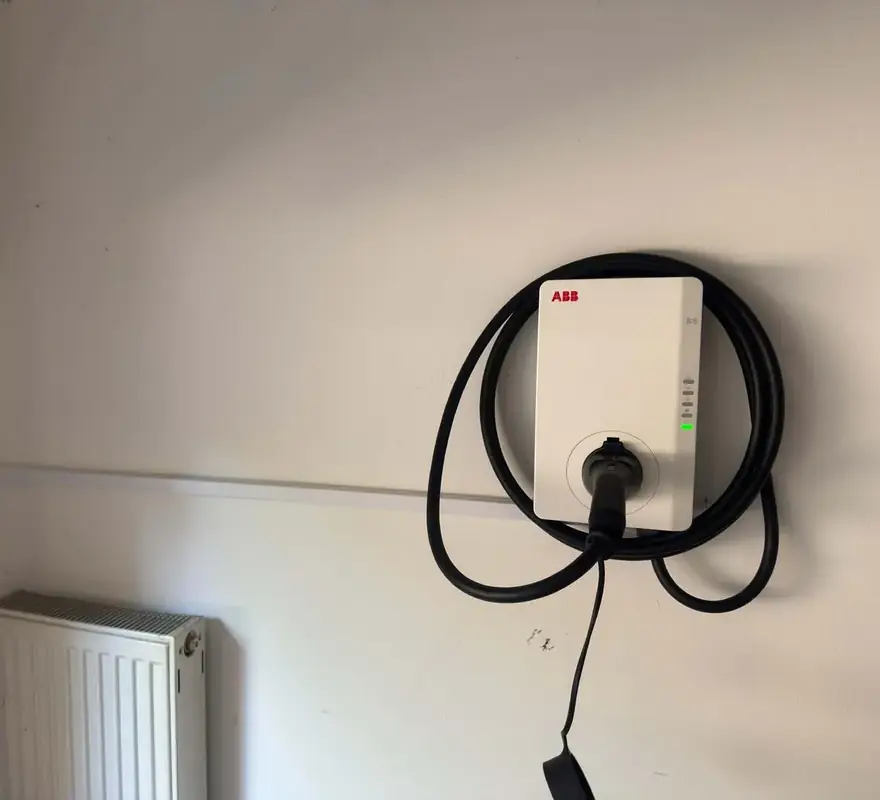
EV charger installation prices 2026: how much does a wallbox cost?
With us, as a package (charger + installation up to a 10 m cable run, final price): from HUF 290,000 with a Besen BASIC 11 kW, from HUF 420,000 with a Wallbox Pulsar Plus 11 kW, from HUF 570,000 with a Voltie 22 kW. Ordered from us together with installation, the charger is not charged at list price.
The total cost of a home charger including the charger is typically HUF 250,000–550,000. The installation part depends on the cable run:
| Item | Material | Labour | Total |
|---|---|---|---|
| Installation, 0–10 m run (cable, protection) | HUF 35,000–55,000 | HUF 45,000–65,000 | HUF 80,000–120,000 |
| Installation, 10–20 m run | HUF 65,000–85,000 | HUF 75,000–95,000 | HUF 140,000–180,000 |
| Distribution board extension if there is no space | HUF 10,000–35,000 | HUF 20,000–45,000 | HUF 30,000–80,000 |
| Electrical safety inspection of the whole house (on request) | – | on quotation, by floor area | on quotation, by floor area |
| Charger (wallbox) | separately, depending on model | included in installation | – |
What makes it more expensive? A long or buried cable run, replacing an old board, a 22 kW version, a capacity increase at the meter. What makes it cheaper? Cable and board space prepared during construction — we always plan this in new houses. We give an itemised price after a site survey: charger, installation and paperwork appear on separate lines in the quotation, so it is transparent.
How can I get a quick quote?
Quick quote: send photos of the meter cabinet, the distribution board and the planned charger location to the email address on the contact page, and we will quote in writing from the photos.
Do I need a permit or a utility notification?
A residential wall charger needs no building permit. If it fits within the existing contracted capacity, it is usually enough to notify the local distribution operator (E.ON, MVM or Opus Titász) of the new load. If not, a capacity increase has to be requested; this takes several weeks, sometimes a few months. We always take care of the paperwork: the whole process – from the application through the meter cabinet work to the completion notice – is run by our partner, a utility-registered electrician.
In a condominium, a charger in a common area also needs the owners’ consent; public chargers follow different rules.
How does the installation work?
- 1Survey
We check the meter (phases, main fuse), the distribution board (space, condition) and the cable route to the charger location, and ask which car the charger is for, how often and when it will be charged.
- 2Quotation
Charger, cable, protection, board extension and paperwork on separate lines, so you can see exactly what costs what.
- 3Paperwork
If needed, notification or capacity increase with the distribution operator; the installation date follows the utility’s procedure.
- 4Installation
Dedicated circuit from the main board, sized cable, circuit breaker and type A-EV or B RCD, mounting the charger.
- 5Commissioning and handover
Setting current limits and modes, connecting the app or KNX, protection tests and test report by our qualified inspector partner, and a walk-through.
Solar PV and EV charging together
If the house has solar panels, the charger can use your own production: the charging current follows the current PV output, so surplus energy during the day stays in the car instead of going to the grid. In a KNX system this is controlled together with the other loads. We also connect the AC side of PV systems, see electrical installation.
Frequently asked questions
How much does wallbox installation cost including the charger?
With us, the charger plus installation up to a 10 m cable run (cable, breaker, RCD, commissioning, test report) costs from HUF 290,000 (Besen BASIC 11 kW), from HUF 420,000 (Wallbox Pulsar Plus 11 kW) and from HUF 570,000 (Voltie 22 kW), final prices as of November 2026. A charger ordered together with installation is not charged at list price. A longer cable run, a board extension or a capacity increase are extra items.
Do you install Voltie chargers?
Yes. For Voltie chargers we are a reseller partner of EVsOLUTION Kft., so we source them with manufacturer warranty and short lead times. With a Voltie 22 kW, the charger plus installation up to a 10 m cable run costs from HUF 570,000 (final price, November 2026), including cable, breaker, RCD, commissioning and test report.
Do you install a charger bought from wallbox.hu or another web shop?
Yes. We install Type 2 wall chargers bought from wallbox.hu or any other web shop: we survey the meter point and the distribution board, build the dedicated circuit with the right cable and protection, mount and commission the charger, and hand over the electrical safety test report. If you have not bought one yet, we help you choose a model that suits the car and the house connection.
Is there a grant for home chargers?
Currently (October 2026) there is no open state grant for private home chargers in Hungary, and there never was a dedicated one: the 2021 private EV programme only supported buying the car.
Can I charge from a normal socket?
Occasionally, with the car’s portable charging cable, but it is slow (about 2.3 kW, 10–12 km per hour), and a standard socket and circuit are not made for hours of near-full load. Regular home charging needs a wall charger on a dedicated circuit.
How is a three-phase EV charger connected?
On a dedicated circuit from the main board: a five-core cable sized for power and length, a three-phase circuit breaker and a type A-EV or B RCD. It is electrician’s work, with protection tests at commissioning.
Which rules apply when installing a charger?
Charging points for electric vehicles are covered by HD 60364-7-722 (MSZ HD 60364-7-722 in Hungary): dedicated circuit, protection that also detects DC fault currents, a suitable cable. The new load has to be notified to the distribution operator, and a capacity increase requested if the connection is not enough.
How can home charging of a company car be accounted for?
The charged energy has to be metered separately: with a charger that has a certified (MID) meter or with a separate sub-meter. How the cost can be settled and taxed is a question for your accountant. If needed, we can recommend our partner accounting firm, konyveloiroda.hu.
How long does the installation take?
The installation itself is short. The lead time depends on whether a capacity increase is needed: the utility’s procedure then takes several weeks, sometimes a few months.
What should be prepared in a new house?
A cable to the garage or carport and space in the distribution board, even if the car only comes years later. Doing it afterwards costs far more than before the walls and floors are finished.
Let’s talk about your project.
Tell us what you are planning and we will get back to you within a few days.
Get in touch