Meter point upgrade, meter relocation and replacement: cost, fees, process
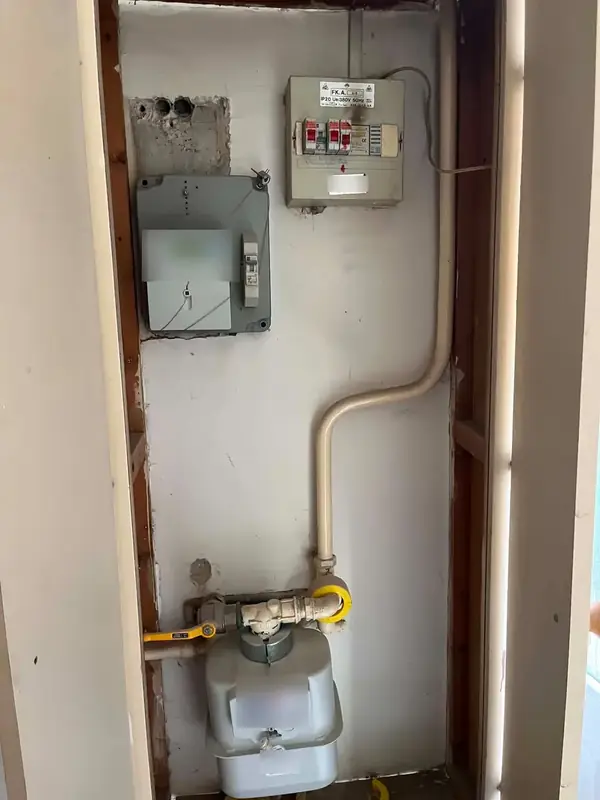
The meter point – the meter cabinet and the unmetered main cable leading to it – is built by the property owner at their own cost, while the meter itself is installed by the distribution operator. According to market data, bringing a meter point up to standard typically costs HUF 145,000–400,000, and relocating the meter HUF 180,000–320,000 depending on the number of phases (joszaki.hu, 2026). No connection fee is due up to 32 A; above that, HUF 3,900/A + VAT is charged on the extra (E.ON, 2026). In Buda and most of Pest county the operator is ELMŰ Hálózati (E.ON group). We file the request, and our registered electrician partner builds the meter point and reports it complete.
What does a meter point upgrade or meter relocation cost?
The cost has two parts: the electrician’s labour and materials (meter cabinet, unmetered main cable, conduit, connection) and the distribution operator’s fees, if any. For the electrician’s part, 2026 market data from joszaki.hu give indicative ranges, including labour and materials:
| Work | Market range (2026) | Source |
|---|---|---|
| Meter point upgrade to standard | HUF 145,000–400,000 | joszaki.hu |
| Meter point upgrade in a family house, complex installation | HUF 250,000–400,000 | joszaki.hu |
| Meter relocation, single-phase | HUF 180,000–260,000 | joszaki.hu |
| Meter relocation, three-phase | HUF 250,000–320,000 | joszaki.hu |
| Meter replacement at an existing, compliant meter point (electrician’s work) | HUF 10,000–80,000 | joszaki.hu |
The price depends mainly on where the meter cabinet goes (at the plot boundary, in a wall or on a plinth), how long the unmetered main cable is, whether the connection is underground or overhead, and whether the capacity is increased as well. We found no reliable market range for replacing the unmetered main cable; we quote it after surveying the route. We give an exact, itemised quotation after a site survey or from photos of the meter point and the distribution board.
What do you pay the distribution operator?
ELMŰ Hálózati’s fee schedule has no separate “meter point upgrade” or “meter relocation” fee. These official fees apply where relevant:
| Fee | Amount | When | Source |
|---|---|---|---|
| Basic connection fee | none | if the sum of the currents requested per phase is at most 32 A (e.g. 1×32 A) | MEKH Decree 13/2025 § 11 (4); VET § 146/A (9) |
| Connection fee above 32 A | HUF 3,900/A + VAT | for a capacity increase, e.g. for 3×16 A = 48 A, HUF 62,400 + VAT for the 16 A above 32 A | E.ON, 2026 |
| Disconnection and reconnection, low voltage | net HUF 15,154 (gross HUF 19,246) | at the customer’s request, e.g. replacing the main breaker within the available capacity | ELMŰ annex F5, 2025 |
| Smart meter installation at the customer’s request | net HUF 12,267 (gross HUF 15,579) | if it is neither mandatory nor the first smart meter you chose | ELMŰ annex F5, 2025 |
| Call-out when the fault is in the customer’s installation | net HUF 10,104 (gross HUF 12,832) | if the operator’s technician finds the fault after the connection point | ELMŰ annex F5, 2025 |
On the day of retrieval we could not find ELMŰ’s 2026 special-fee schedule on the E.ON website, so the special fees above come from the 2025 annex; the exact amount is stated in the operator’s technical and economic offer (MGT).
What does replacing an electricity meter cost?
The meter belongs to the distribution operator, which also replaces it. Whether you pay depends on the reason:
- Periodic (calibration) replacement: free. For customers, the cost of installing and calibrating the meter is borne by the operator (VET § 41), and replacement because calibration has expired is not a special-fee service (MEKH Decree 10/2024 § 31 (1) 1).
- Mandatory smart meter replacement: free. The cost of meter point alterations needed for the smart meter is also borne by the network operator (VET § 178/A (2)). It is mandatory, for example, for new connections or upgrades of at least 3×32 A and for household-scale generators such as PV systems (VET implementing decree § 14/B).
- The first smart meter installed at your own request: free under § 14/B (2a) of the implementing decree; any further smart meter installation on request is a special-fee service (see the table above).
- If the old meter point is not fit for the replacement (wooden box, cannot be sealed, no room for the meter), the owner has to put it right; that is a meter point upgrade and electrician’s work.
What is a compliant meter point?
According to ELMŰ Hálózati’s business rules, building the meter point at the connection point is the customer’s task, and under § 14 (7) of the VET implementing decree it is done at their own cost. For new meter points, relocations, refurbishments and capacity upgrades, the main requirements are:
- A type-approved meter cabinet with at least IP44 protection (ELMŰ business rules 10.1).
- At the plot boundary or no more than 2 m from it, accessible from outside (ELMŰ annex M5 5.4.4.4).
- Operable height and free space: controls between 0.6 and 1.8 m, at least 1 m² of free space in front of the cabinet (E.ON meter point requirements).
- No individual design needed if a registered electrician does the work with a contractor’s declaration and, for underground or auxiliary-pole connections, the cabinet is at the public plot boundary or within 1 m of it (ELMŰ business rules 10.1).
In apartment buildings, the 2025 MEE-VET guideline requires a new cabinet for relocation, for single- to three-phase conversion, if the condition is poor, or if the meter point cannot take the upgrade; a sealable meter point that met the standard when it was built can be kept.
Unmetered main cable: who owns it, and when must it be replaced?
The unmetered main cable connects the public grid’s connection point to the meter. The connection point is the ownership boundary (VET § 3 (5)), so the unmetered cable behind it belongs to the customer, who also pays for its maintenance and replacement (ELMŰ business rules 2.40.1 and 8.3). Because it is not metered, only the operator, or an authorised electrician with its consent, may work on it.
- When must it be replaced? If the upgrade only needs a new main breaker and the cable’s cross-section and number of phases are adequate, rebuilding it may not be required. If the upgrade needs a new main cable or service cable, the rules for new buildings apply (ELMŰ M5 5.5.1–5.5.2).
- Technical conditions: the system user builds it from the connection point to the meter point; the permitted voltage drop is 1 % and the conduit at least 36 mm (ELMŰ M5 5.4.4.6).
- In apartment buildings, replacing the main cable needs the written consent of the owners or the building manager.
Bringing power to a plot: fees for a new connection
For a new building plot, the operator builds the service cable (from the grid to the connection point), which remains its property (VET § 3 (6)); the owner has the meter point and the unmetered main cable built. The operator’s fees in 2026:
| Item | Fee | Source |
|---|---|---|
| Connection up to 32 A (sum of phase currents) | no basic connection fee | MEKH Decree 13/2025 § 11 (4) |
| The part above 32 A | HUF 3,900/A + VAT | E.ON, 2026 |
| Free network length up to 32 A | overhead line 100 m, underground cable 50 m | MEKH Decree 13/2025 § 12 (2) |
| Free network length above 32 A | overhead line 50 m, underground cable 25 m | MEKH Decree 13/2025 § 12 (2) |
| Low-voltage public line beyond the free length | overhead HUF 5,300/m, underground HUF 8,500/m + VAT | E.ON, 2026 |
If the owner asks for a more expensive solution than the least-cost one (for example an underground cable instead of an overhead line), 70 % of the difference in value is also payable (MEKH Decree 13/2025 § 13). Within built-up areas new lines are, as a rule, laid underground; the exception is a service cable to an existing low-voltage overhead network (VET § 33/E). If the connection is increased above 32 A within 5 years, the network length is settled retrospectively (§ 12 (10)).
What is equipotential bonding (EPH), and why does it matter at the meter point?
Main equipotential bonding (in Hungarian EPH) connects the metal pipework (water, gas, heating), metal structures and the protective conductor at one point, so that no dangerous voltage can arise between them. According to an MVM technical specification, the bonding node and the earthing must be at the main distribution board or right next to it, so it makes sense to sort it out together with the meter point and the main board.
Connecting the bonding is electrician’s work that we hand over with protection tests and a test report; for a check of the whole house see electrical safety inspection. We found no reliable market range for it, so we quote based on the site.
How does a meter point upgrade or meter relocation work?
The steps below are based on ELMŰ Hálózati’s connection process and business rules:
- SurveyWe check the existing meter point, the unmetered main cable and the main board, and work out how much capacity you need now and later (EV charger, heat pump, solar).
- ApplicationOnline or on a form with the operator; with a written authorisation, the electrician can file it. Meter relocation and capacity upgrade can be requested together.
- Technical and economic offer (MGT)The operator sends the technical conditions and the fees. At ELMŰ you have 60 days to accept the MGT for an overhead connection and 30 days for an underground one.
- Payment and contractsIf a connection fee is due, the contracts can be signed after payment.
- Building the meter point, completion reportA registered electrician builds the compliant meter point and the unmetered main cable and reports completion with a contractor’s declaration.
- Meter installation and connectionUnder ELMŰ’s business rules the meter is installed and connected within 3 working days of the contract taking effect and the meter point being compliant.
What do we take on?
We survey the meter point, the main cable and the distribution board and file the request with the operator; our registered electrician partner builds the meter point and reports it complete. We carry out the internal installation to MSZ HD 60364 with protection tests and a test report. We work in Buda (districts I, II, III, XI, XII) and the Buda suburbs. Related work: capacity upgrade and three-phase supply, electrical installation, EV charger installation.
Frequently asked questions
What does replacing an electricity meter cost?
Periodic (calibration) replacement and mandatory smart meter replacement are done free of charge by the operator. If the old meter point is not fit for the replacement, the owner has to have it brought up to standard; the market price for that is typically HUF 145,000–400,000 (joszaki.hu, 2026).
What does a meter point upgrade cost?
According to market data, typically HUF 145,000–400,000, and HUF 250,000–400,000 for a family house with a complex installation (joszaki.hu, 2026). If the capacity is increased too, the operator charges HUF 3,900/A + VAT on the part above 32 A.
What does relocating an electricity meter cost?
According to market data, HUF 180,000–260,000 for a single-phase and HUF 250,000–320,000 for a three-phase meter (joszaki.hu, 2026). ELMŰ Hálózati has no separate meter relocation fee.
Who pays for replacing the unmetered main cable?
The customer: the unmetered cable behind the connection point is their property (VET § 3, ELMŰ business rules). If the upgrade only needs a new main breaker, replacement cannot be required as long as the cross-section and number of phases are adequate.
What does it cost to bring power to a plot?
Up to 32 A there is no basic connection fee, and the network is free up to 100 m of overhead line or 50 m of underground cable; beyond that, E.ON’s 2026 fees are HUF 3,900/A and HUF 5,300/m overhead or HUF 8,500/m underground + VAT. The owner has the meter point and the unmetered main cable built.
Do I need an electrician for a meter point upgrade?
Yes. A registered electrician builds the meter point and reports it complete; in our case this is done by our registered electrician partner.
Let’s talk about your project.
Tell us what you are planning and we will get back to you within a few days.
Get in touch