LED lighting and lighting control
Good LED lighting and lighting control depends less on the fitting and more on having the cable, the driver and the control in place before the plasterboard goes up. We install hidden LED strips, ceiling downlights, stair and garden lighting, light fittings and chandeliers, and set up dimming and DALI, KNX or Casambi control – in Buda and its suburbs, in new builds and renovations.
What lighting work do we do?
The complete lighting of a flat or house: from cabling and driver placement through fitting the lights to programming the control. In a new build as part of the electrical design, in an existing building after a survey.
| Work | What it includes | What we watch |
|---|---|---|
| Hidden LED lighting | LED strip in aluminium profile in drywall, suspended ceilings, cornices, behind shelves and mirrors | driver location and ventilation, voltage drop, access |
| Ceiling downlights | recessed LED spots, downlights, track systems | installation depth, heat, even light |
| Kitchen worktop lighting | LED strip or profile under the wall units, switched or sensor-controlled | driver in the cabinet, splashes |
| Stair and corridor lighting | step lights, motion or presence sensor control, night orientation light | a cable to every step during construction |
| Garden and façade | garden lights, façade and entrance lighting, dusk switch, timer | outdoor rating (IP), buried cable, RCD |
| Light fittings and chandeliers | connecting and suspending ceiling and wall lights and chandeliers | protective earth, load-bearing fixing, bathroom zones |
| Dimming | matching dimmer switches and dimmable drivers | compatibility, minimum load, flicker |
| Lighting control | DALI, KNX–DALI gateway, Casambi, scenes, tunable white | planned early, addressing and programming |
| Emergency lighting | installing escape and exit-sign lighting, periodic testing, log book | required duration, positioning, documentation |
We do not work from a price list: the itemised quote is based on a site survey or the design, as the job can range from replacing one fitting to the controlled lighting of an entire house.
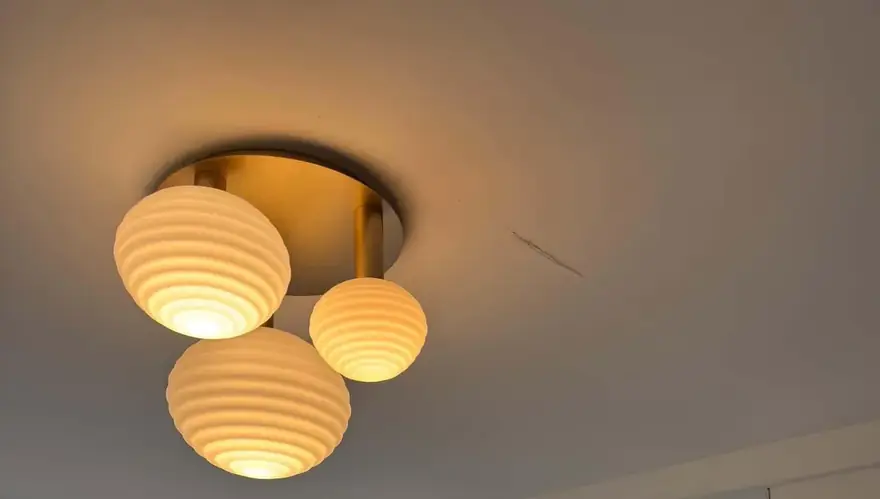
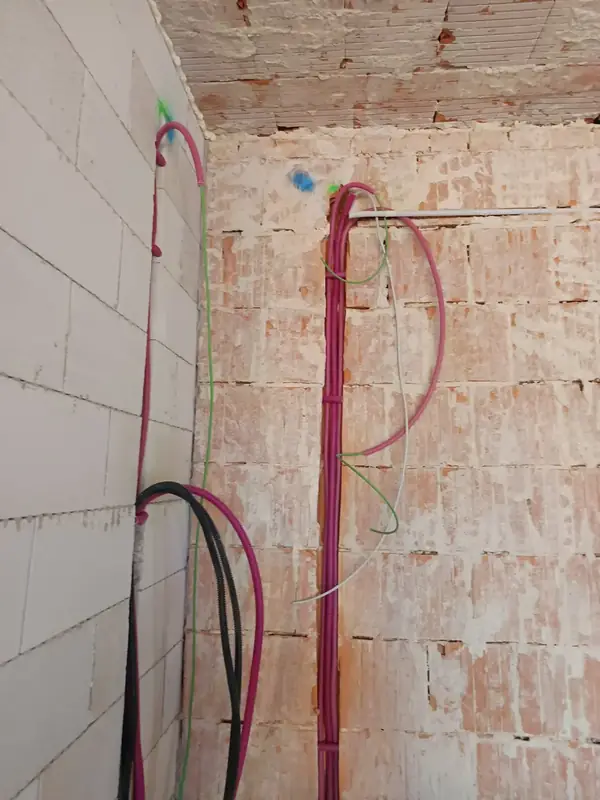
What has to be decided before the drywall goes up?
Every light whose cable or driver ends up behind the plasterboard: where the LED strips go and in which profile, where the downlights sit, where the driver goes so that it stays accessible and ventilated, and what kind of control you want. Once the boards are up, the same work means opening and repairing them.
- Light source and position – strip or spot, profile type, direction of light (up, down, onto the wall).
- Driver – its power and location; on long strips, where to feed in because of voltage drop.
- Dimming – if you want it later, the driver and the switch have to match now.
- Control – plain switch, sensor or bus (DALI, KNX): the bus cable goes into the wall now too.
In detail: hidden LED strip lighting in drywall.
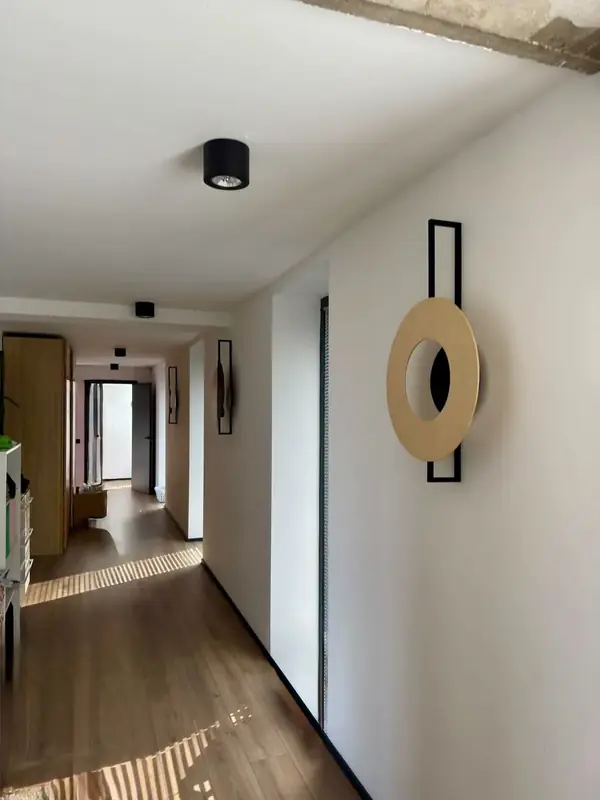
Why should an electrician connect a light fitting?
Because connecting a light is a matter of shock protection: a metal fitting must be connected to the protective earth, the switch must break the live conductor, and lighting circuits in a home should also be protected by a 30 mA RCD. A wrong connection can go unnoticed for years, but in a fault the fitting can become live.
- Existing wiring – older houses often have no earth conductor or aluminium wiring; we check this first and tell you what needs doing.
- Fixing – with a heavy chandelier, the ceiling’s load capacity and the suspension matter as much as the wiring.
- Bathroom and outdoors – the fitting’s IP rating must suit the location; in bathrooms according to the zones.
We fit single lights and chandeliers too, but usually several in one visit, together with other electrical work. If the condition of the power installation is in doubt, an electrical safety inspection gives a clear picture.
When is a dimmer enough, and when do you need DALI, KNX or Casambi?
To dim one or two lights, an LED dimmer switch that matches the lamp or driver is enough – that keeps the light from flickering (LED dimmer switches). For several rooms, scenes, sensors or colour-temperature control you need a control system.
| Solution | How it works | Best for |
|---|---|---|
| Dimmer switch | the switch regulates the mains voltage | single rooms, dimmable lamps or drivers |
| DALI | digital control bus (IEC 62386); every light individually addressable, up to 64 control gear per line | many lights, scenes, tunable white (DALI DT8) |
| KNX + DALI gateway | KNX controls the whole house, DALI the lights | when the house is a KNX smart home |
| Casambi | wireless Bluetooth Low Energy network, phone app | renovations without a bus cable; furniture and strip lighting |
We have already installed DALI, Casambi and tunable white systems in family homes. Tunable white means adjustable colour temperature: cooler white in the morning, warmer in the evening, from the same fitting. In detail: DALI lighting control: DALI, KNX or Casambi?
Human centric lighting (HCL): light that follows the time of day
Human centric lighting (HCL) is smart lighting that adapts the amount and colour temperature of light to the time of day: more and cooler white light during the day, less and warmer light in the evening. It needs tunable white LED strips or luminaires (typically 2700–6500 K) with DALI DT8 drivers; in a KNX house the KNX time program sends colour temperature and brightness through the KNX–DALI gateway, without KNX a stand-alone DALI controller or Casambi does the job.
- Home office: ample neutral or cooler light for work during the day, warm, subdued light in the evening from the same luminaire.
- Children’s room: a warm, low evening mode at the push of a button or on a schedule.
- Older residents: older eyes need more light for the same task; we take this into account in the design.
HCL is a comfort and lighting design solution, not a medical device. About DT8 drivers: DALI lighting control · Standards, the non-visual effects of light and design: Human centric lighting and tunable white in a family home
Motion or presence sensor on stairs and corridors?
Motion sensors on stairs and corridors, presence sensors where people sit or stand. A motion sensor reacts to someone passing; a presence sensor also detects small movements, so it does not switch the light off while someone is in the room, and it can take daylight into account. Step lighting needs a cable to every step, best run during construction or before the stairs are clad.
Do you also install and test emergency lighting?
Yes. Where the fire regulations or the fire safety design require it – offices, shops, common areas of apartment buildings, workplaces – we install escape and exit-sign lighting and carry out the periodic tests, keeping the log book. Where it is required and what has to be tested: emergency lighting in Hungary.
How does the job work?
- SurveyWe walk the site: rooms, the lighting effects you want, existing wiring, driver and distribution board locations.
- Plan and quotePosition and type per light, circuits, drivers and control; an itemised quote.
- CablingMains cable, LED supply cable and bus cable where needed – before drywall and plastering.
- InstallationLED profiles, strips, downlights, fittings, drivers, switches and sensors.
- Setup and programmingDimming tuned, DALI addressing, groups and scenes, sensor sensitivity and timing.
- HandoverWalkthrough, measurements and documentation: circuits, driver locations, control settings.
Related articles from our knowledge base
LED profile, driver location, voltage drop, dimming – what to settle before the plasterboard goes up.
Read →Leading or trailing edge, minimum load, dimmable bulbs and drivers – how to stop LED flicker.
Read →What DALI does, when you need a KNX–DALI gateway, and when wireless Casambi is enough.
Read →Light that follows the time of day: what standards say about non-visual effects, and how to build it with DALI DT8, KNX or Casambi.
Read →Which wire goes where, changing a light safely, motion sensor lights and chandeliers – and when to call an electrician.
Read →Buried cable and conduit, IP ratings, RCDs, dusk sensors, motion sensors, extra-low voltage – and facade lighting.
Read →What the standard allows in zones 0, 1 and 2, which IP rating you need, where switches go, and good light at the mirror.
Read →General, task and accent light, the height of the dining pendant, and what to decide before drywall and tiling.
Read →What Ra measures, why R9 matters, what TM-30 adds, and what EN 12464-1 and the EU ecodesign rules require.
Read →DALI-2, D4i, DT6/DT8, KNX–DALI gateways (MDT, Gira, ABB, Lunatone) – what to check, based on datasheets.
Read →230 V vs 24/48 V track, run length and power supply, recessed installation in drywall, DALI/KNX control and popular systems from manufacturer data.
Read →Escape and exit-sign lighting, the Hungarian fire code and standards, duration, periodic testing and the log.
Read →Frequently asked questions
How much does LED lighting installation cost?
Jobs vary widely – from connecting one light to the controlled lighting of an entire house – so we do not publish a price list. We prepare an itemised quote based on a site survey or the electrical design.
Do you fit single lights or chandeliers?
Yes. We fit lights and chandeliers, checking the protective earth and the load capacity of the suspension as well. It is more economical to have several lights or other electrical work done in one visit.
When should I call you about hidden LED lighting in drywall?
Before the drywall goes up, when the frame is in place but the boards are not. That is when the cable, the driver and the support for the LED profile go in.
Why does my LED light flicker with the dimmer?
Most often because the dimmer and the LED lamp or driver do not match, or the load is below the dimmer’s minimum. Choosing a suitable dimmer and a dimmable driver solves it.
What is the difference between DALI and Casambi?
DALI is a wired control bus with its own pair of conductors – ideal for new builds and major renovations. Casambi is wireless, Bluetooth-based and set from a phone – good where a bus cable cannot be added later. We work with both.
Do you also test existing emergency lighting?
Yes, we carry out periodic testing of existing emergency lighting, keep the log book and replace faulty fittings where needed.
Let’s talk about your project.
Tell us what you are planning and we will get back to you within a few days.
Get in touch